The Future Is Human, Not Technological
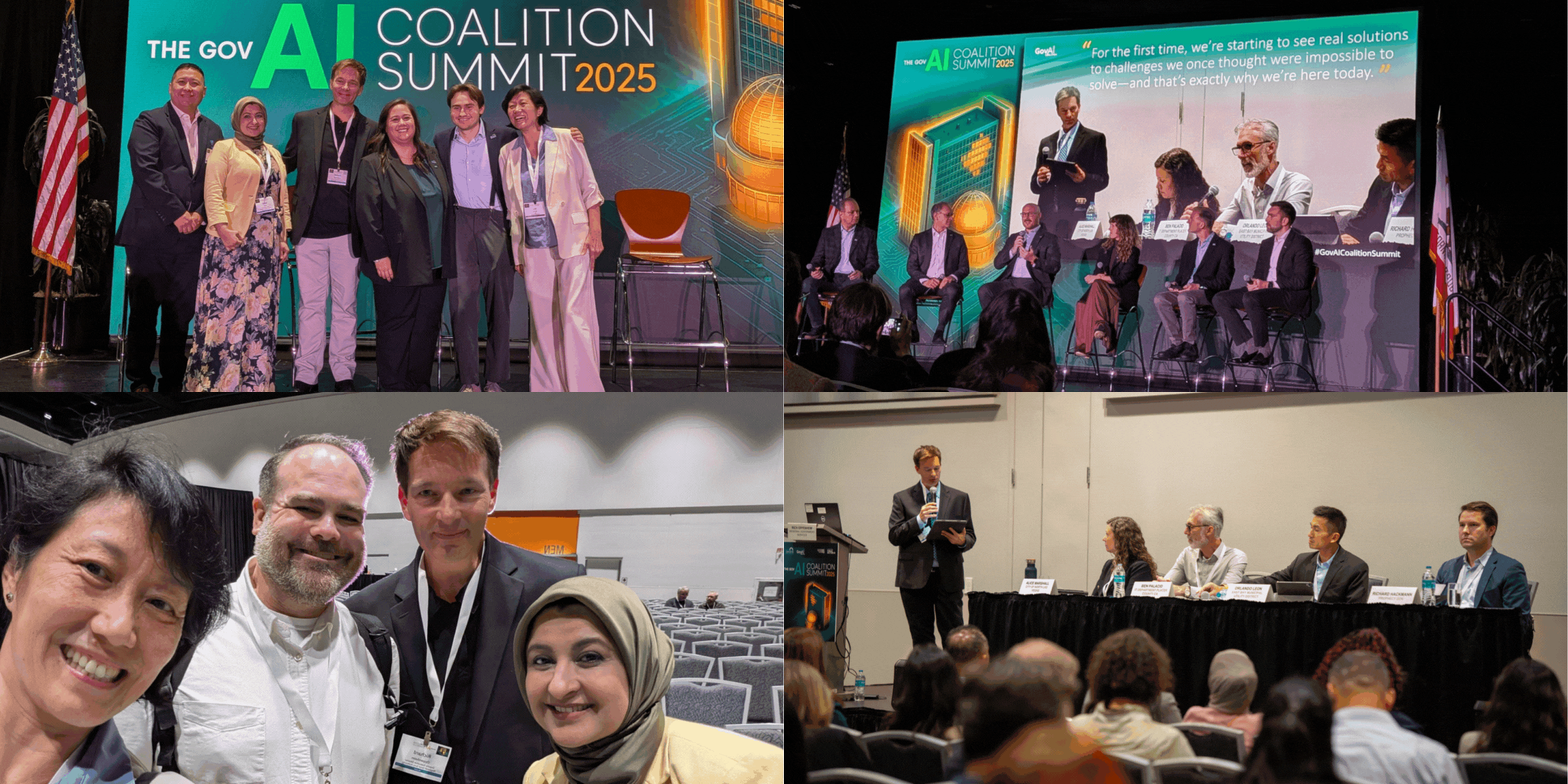
By Richard Oppenheim, Deputy Executive Director, Regional Government Services (RGS)
Over the last year, conversations about artificial intelligence (AI) have moved from speculation and curiosity to concrete questions about readiness, governance, and integration across local government. In 2023, AI felt like a distant horizon; by the end of 2024, it became a daily conversation in staff meetings, leadership teams, and agency councils.
RGS continues to explore AI for our own internal operations and our client agencies. Additionally, RGS is a member of the GovAI Coalition, a nationwide collaborative of more than 600 local government agencies developing AI resources and guidance for local government agencies. I have co-chaired the Coalition’s Readiness and Adoption Committee, focusing on AI policy, AI education, and workforce/ change management.
After a year of national conversations, cross-agency collaboration, and hands-on pilots, one message has rung the loudest:
AI is not just a technology issue. It is a people issue.
This is one of the most important insights we can bring to public-sector agencies. Local governments will succeed with AI only if we invest first in people, culture, systems, and responsible decision-making.
Purpose First, Not Technology First
At the 2025 GovAI Coalition Summit, more than 600 professionals explored progress and hurdles in public-sector AI adoption. One key takeaway was:
Local government is not in the tech business. We are in the people business.
This emphasis is crucial. Too often, agencies feel pressure to “do something with AI” because everyone else seems to be. But the real question isn’t “How do we accelerate our use of AI?” but “What fundamental problem are we trying to solve?”
This aligns strongly with national guidance. The ICMA Local Government AI Strategy Workbook reminds agencies to begin not with tools but with strategic intent—understanding their community’s needs, defining the problem space, and aligning AI with existing plans and values.
Similarly, the National League of Cities NLC AI Toolkit emphasizes that cities begin AI adoption with a deep understanding of their organizational context, risks, and values, not with a tool comparison.
Four Key Reasons Local Governments Can’t Ignore AI
Across counties, cities, joint powers authorities, and special districts, several forces are pushing AI from curiosity to strategic priority.
- Work Is Already Changing
AI is fundamentally reshaping tasks, roles, and expectations in both the public and private sectors. At the Summit, multiple panelists noted that new roles (AI coordinators, prompt engineers, data stewards) are emerging. But the even larger shift is that every role will soon require some level of AI literacy. And this has implications for redefined job descriptions, performance management, workforces, and organizational cultures.
The National Association of Counties’ AI County Compass highlights the same dynamic, noting that county governments must prepare for upskilling and reconfiguration of the future workforce as AI becomes integrated into operations.
- Residents Expect Modern, Responsive Services
AI-powered experiences are now standard in daily life, from real-time translation to natural-language search, automated summarization, etc. The public expects government to meet a similar standard of accessibility and clarity.
- Misinformation and Deepfakes Are Rising
AI is reshaping the information landscape. Local governments now face new risks related to fraudulent, intentional misinformation campaigns using a variety of media. This can impact local government credibility, clarity, and public trust. We must develop solutions to reduce them.
- AI Can Strengthen Capacity, Not Replace People
AI is best used to expand human capacity, not replace human expertise.
We want employees focused on high-value thinking, relationship-building, and community service rather than repetitive administrative burden. AI can help with that, but only when implemented thoughtfully.
AI Adoption Is Change Management
Since AI is a people issue, we must look at the systems people work and live in. AI doesn’t operate in a silo. When we introduce AI into any part of local government, it interacts with everything already in place: how work gets done, who is involved, how decisions are made, and how people experience services.
In his article, “From Principles to Practice: How Organizations Can Actually Live Their Responsible AI Commitment,” Charley Johnson highlights an important but often-overlooked reality: adopting AI means intervening in an existing sociotechnical system, not simply installing new software. AI inevitably touches the underlying elements of that system, such as relationships, incentives, norms, assumptions, and authority structures.
In practice, this means AI adoption (or any new technology), should be approached as an organizational change management effort, not solely an IT upgrade. Governments must examine their workflows, culture, values, and historical patterns before introducing AI. Without this reflection, AI will reinforce whatever already exists in the system, including any inefficiencies, inequities, biases, or bottlenecks.
The GovAI Coalition’s Readiness and Adoption Committee has recently kicked off a Workforce and Change Management working group to address these issues.
Workforce Readiness: The Heart of Responsible AI
A key component of people-focused organizational change is workforce development. At the GovAI Coalition’s Annual Summit, AI literacy and education were mentioned in every session, regardless of the topic. It is foundational because AI is permeating every aspect of how we work and the systems in which we work.
NACo, ICMA, and NLC all came to the same conclusion:
People, not tools, determine whether AI is responsible and effective.
Agencies must therefore invest in:
- foundational AI literacy for every employee
- role-specific training for HR, finance, planning, public safety, and administration
- leadership readiness for evaluating and governing AI
- supervisor skills for reviewing performance
- safe-to-fail cultures that encourage experimentation
- organizational change strategies, not tool rollouts
AI changes so fast — and changes the work government and public servants do. This means training has to become part of the system that keeps government functioning safely, legally, and effectively. Training can no longer be occasional support but must evolve into a tool that allows staff to adapt, make good decisions, and manage risk.
Leadership’s Role in Shaping AI’s Future
As we enter 2026, the question for public agencies is not whether AI will reshape work. It already has. The question is whether leaders will guide that change intentionally.
To do this well, agencies must invest in:
- people
- training
- communication
- system redesign
- governance
- culture
AI will not replace human judgment. But people who understand AI, including its risks, system interactions, limitations, and opportunities, will shape the future of government.
AI is not a tech challenge. It is a leadership challenge.
And we are ready to meet it—together.
Share this article
Stay Up-To-Date - Follow RGS on LinkedIn:
Latest articles
April 1, 2026

March 16, 2026
March 16, 2026